

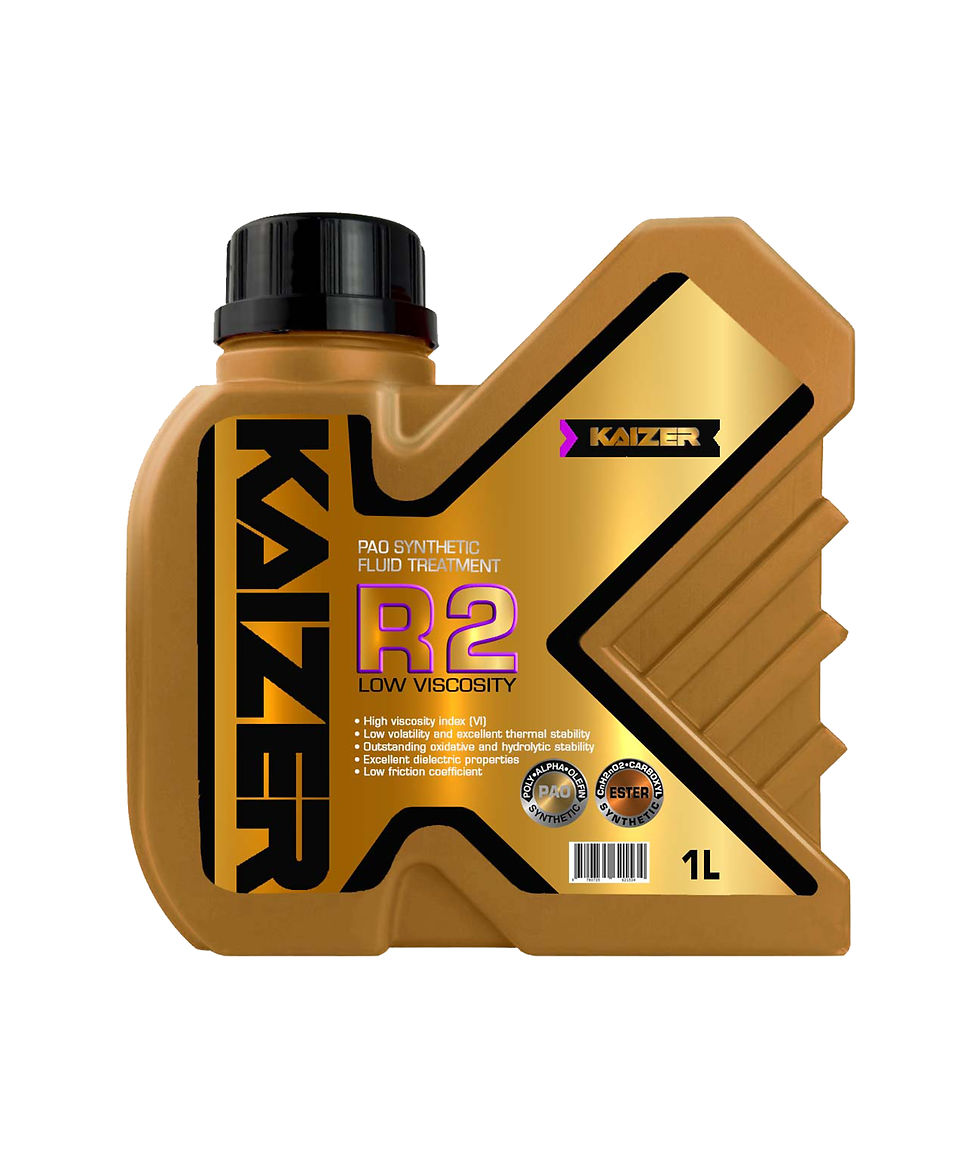


KAIZER PAO TREATMENT
PAO Synthetic Fluid ViscosityTreatment
High Stability PAO Viscosity Treatment
Kaizer R Series is a PAO based synthetic fluid treatment designed to adjust and stabilize engine oil viscosity for specific driving requirements. The formulation enhances film strength, thermal and oxidative stability, and overall lubrication consistency across varying temperature and load conditions.
Applications
KAIZER PAO Synthetic Fluid Viscosity Treatment R Series is designed to support lubrication stability under demanding conditions. The R Series is suitable for engines and fluid systems that require improved viscosity behavior and lubrication consistency over time. It is designed for use in situations where thermal stress, shear forces, or extended operation can affect fluid performance. The R Series supports applications where maintaining stable lubrication characteristics is critical to engine protection and smooth operation.
Key Features
PAO-based formulation for controlled viscosity behavior
KAIZER PAO Synthetic Fluid Viscosity Treatment R Series is formulated using PAO-based synthetic components to support stable viscosity characteristics.
It helps reinforce the lubrication film, improve resistance to thermal stress, and maintain consistent fluid behavior under varying operating conditions.
By supporting viscosity stability and lubrication balance, the R Series contributes to smoother operation and sustained system protection.
Oxidation Stability and PAO Treatment Performance
* RPVOT (Rotating Pressure Vessel Oxidation Test)
A leading international standard test used to evaluate
the oxidation stability of lubricating oils.

This chart illustrates oxidation stability measured through the RPVOT test, a widely recognized method for evaluating how well lubricating fluids resist oxidative degradation over time. In the test, higher RPVOT time indicates stronger resistance to oxidation and longer retention of lubricant performance.
Compared to conventional Group II and Group III base oils, PAO-based formulations demonstrate significantly extended oxidation stability. KAIZER PAO Synthetic Fluid Viscosity Treatment R Series is designed to leverage this inherent advantage of PAO chemistry by supporting viscosity stability and reinforcing lubrication behavior under thermal stress.
By enhancing resistance to oxidation, the R Series helps slow down oil degradation, maintain viscosity characteristics, and preserve lubrication balance during extended operation. This directly contributes to smoother operation, reduced performance drop over time, and sustained engine protection in demanding conditions.
Specific Heat Capacity and Thermal Control

This chart illustrates the specific heat capacity of different base oil types across a range of temperatures. Specific heat capacity indicates how much thermal energy a fluid can absorb before its temperature rises. A higher specific heat capacity means the fluid can manage heat more effectively, helping to stabilize operating temperatures under load.
PAO-based fluids demonstrate consistently higher specific heat capacity compared to Group II and Group III base oils, particularly as temperature increases.
This characteristic allows PAO-based lubrication systems to absorb and distribute heat more efficiently during operation.
KAIZER PAO Synthetic Fluid Viscosity Treatment R Series is designed to take advantage of this thermal behavior by supporting heat management within the lubrication system. By helping fluids handle thermal energy more effectively, the R Series contributes to improved thermal stability, reduced heat-related stress, and more consistent lubrication performance during extended or high-temperature operation.
Energy Efficiency and Friction Behavior

PAO 4-based oils show 14.7 percent lower friction in the full-film lubrication region compared to Group III oils.
The chart on the left illustrates the advantages of PAO-based 0W-20 oils.
Lower friction means that moving components operate with less resistance, which directly contributes to improved energy efficiency.
This chart illustrates traction coefficient behavior across rolling speed, highlighting how different base oil types perform under full-film lubrication conditions. Lower traction coefficient indicates reduced internal friction, allowing moving components to operate with less resistance.
PAO-based fluids consistently demonstrate lower traction coefficients compared to conventional Group II oils, particularly in the full-film lubrication region. This reduced friction means less energy is lost to internal resistance, allowing more of the engine’s energy to be used for actual mechanical output.
KAIZER PAO Synthetic Fluid Viscosity Treatment R Series is designed to support this low-friction behavior by helping maintain stable lubrication characteristics under varying speeds and loads. By reducing frictional losses and supporting efficient lubrication flow, the R Series contributes to improved energy efficiency, smoother operation, and more responsive system behavior during real driving conditions.
INDIVIDUAL PRODUCT FEATURES
KAIZER R2 l Low Viscosity
Designed for Enhanced Fluidity and Reduced Friction
R2 improves low temperature fluidity and reduces internal resistance. Ideal for drivers seeking better cold start protection and smooth response without increasing oil thickness.
• Low temperature fluidity improvement
• Enhanced engine responsiveness
• Fuel efficiency support
• Reduced friction
KAIZER R3 l Middle Viscosity
Balanced Viscosity Reinforcement for Daily and Heavy Use
R3 increases film durability and thermal stability without excessive thickening. Suitable for city driving, high temperature operation, and mixed conditions.
• Improved film durability
• High temperature stability
• Enhanced oxidation resistance
• Better overall protection
KAIZER R5 l High Viscosity
Heavy Duty Protection for High Heat and Load
R5 significantly increases oil film thickness and strength, making it ideal for engines exposed to severe temperatures, load, towing, or long distance driving.
• Thicker and stronger oil film
• Heat and load stability
• Reduced wear
• Enhanced durability